Greetings from Lago Atitlàn. My spirits lifted almost as soon as I left Antigua Saturday morning. I had interesting companions on my journey to Panajachel, the village that is the ¨doorway¨to the Lake, and ended up spending the day with them. After checking my luggage in my little hospedaje, where I have a lovely room for $10 a day (my first hotel on this trip, after 40-plus days of family stays and church dormitories), I joined them for a trip to San Juan La Laguna, a small Mayan town on the west end of the lake.
Like Crater Lake or Lake Chelan, Lago Atitlàn is in arid country, surrounded by volcanoes and hills that plunge steeply down to the shoreline. (Click here for a bunch of photos taken by other people.) You can pay a lot for a tour to several communities in a big boat (I'll do that tomorrow) or pay less and join the locals in a invigorating, speedy, spray-filled trip in a lancha (click here for a photo) to a particular village. Which we did, to arrive at a quiet, peaceful, hillside community where my new friends took a room in a little blue-and-white hotel and we enjoyed ice cream and licuadas, (fruit and water, stirred up in a blender) before I took the lancha back to "Pana".
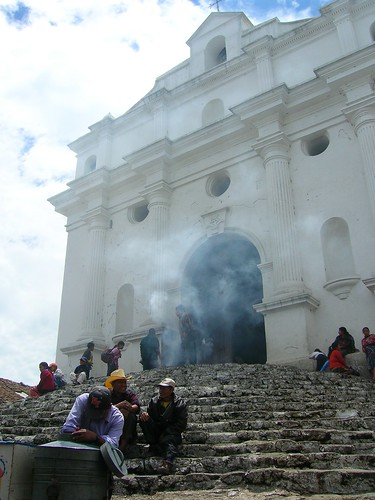
Today I went to Chichicastenango, home of the biggest indigenous market in Guatemala. But instead of shopping, I explored Chichi's Mayan-Catholic churches and rituals. 18 steps lead up to San Tomas, the so-called ¨Church of Life,¨ one for each month in the Mayan solar calendar. At the top of the steps half a dozen men were swinging containers of incense around them. The guide I hired explained that they were Mayan shamans (is the plural shamans, or shamen?) purifying themselves to enter the church and lead prayers and rituals. (No, I can't post my photos yet; click here for an image from someone else's blog.)
Inside the church, where photos are not allowed, the area behind the altar rail and along the side walls is devoted to Catholic ritual. Down the center aisle on the floor are square wooden altars about 6 inches high on which candles are guttering and next to which the shamans kneel. In order, I encountered altars for curing children, cuiring infertility or influencing the gender of your next child, six altars for the harvest (three for corn, one for fruit, and one for beans), an altar for relationships (marriages and courtships), and, closest to the main Catholic altar, one for giving thanks to the god of man, the sun, and the god of women, the moon.
In the Catholic section, you can light your own candle or say your own prayer, but down this middle aisle, you need a shaman. The wooden altars around the church where paintings of saints once appeared were black with smoke and incense, and the church was thronged. Some children were being baptized, but more important, said the guide, is to take them to the shaman to find out their destiny (farmer? business person? shaman?) and then by the age of 10, apprentice them to someone who can help them reach their destiny.
Across the plaza and part of the market (the market takes over the whole town) was El Calvario, the church of death, where more floor altars receive prayers and rituals for dead men, women, and children. Prayers for children are to deliver them to their ancestors, who the children will serve. Likewise women go to serve their ancestors. 13 steps led up to this church, the number of months in the Mayan lunar calendar. In a side altar, shamans performed rituals for protection and safety, like on a bus trip to Guatemala City.
Then the guide led me up the hill to Pascual Abaj, where shamans work outdoors. My photos are WAY BETTER but click here to visualize what I am about to tell you. Two shamans were at work, a man and a woman, around a hillside charred with old fires (some not so old; you had to watch where you stepped, just like on that volcano last week!) and new fires, into which they threw things. As I arrived, the woman shaman was blessing the man with a live chicken, passing it around all the parts of his body. Passing the chicken around his legs would ensure safety while walking. Passing it around his head and mouth would help him concentrate better on his tasks and give him words for interpretation. Then the chicken's head was cut off, and its blood squeezed into the fire. And then, just like the saying goes, the chicken ran all around with its head cut off. My guide said that's a sign of good luck and many journeys. Beware the chicken that falls over and dies immediately! No journeys, or maybe journeys with robbers and flat tires.
In the center of the circle, in front of the altar, stood a bottle of coke and a bottle of beer. The coke was for the corazon del cielo, the heart of the sky. The beer was for the corazon del tierra, the heart of the earth. Why might this be? My guide asked. My lame guess was, because the coke is carbonated and the bubbles are going up?? No. The sky gods don't get liquor because because they are saints (Catholic influence here). The earth gets beer cuz it will placate (or reject) the bad spirits below.
On the altar stood a Mayan cross (the Mayans had a cross before the Spanish got there, but it had arms of equal lengths), a Christian cross, and the large stone symboling Pascual Abaj. Radiating from the central point of the circle (remember the beer and the coke) were four outer places to send prayers to the four arrows or directions.
I have pictures of all of this. The Popol Vuh, the Mayan holy book, also confirms it. That this amazing syncretism of religions happened is due to Fr. Francisco Jimenez, who was interested, about 400 years ago, in the creation stories of the Maya, and ¨discovered¨and read the Popol Vuh to learn more, thus gaining the respect of the local community, which moved its gods back to the church.
"Discovered" is in quotes because I read recently that no one can really ¨discover¨a new place or culture. Columbus, Cortez, and the rest of the conquistadores did not discover but rather invented America. They interpreted what they saw through their own lens and, not understanding it, made up some awfully tall tales about what they were seeing.
That happens every day of my journey! I see something or hear a word or phrase I don't know, and invent an explanation. Later, when someone explains, I can see just how far off I am. Every gringo I meet here is completely inventing explanations for the government, the culture, and the society. The humble ones admit this up front; the rest are "experts."
Tomorrow I get my gringo tour of the lake, meet my new friends from Saturday for supper, and then on Monday I take a chicken bus to Santa Cruz de Quichè, where I will be visiting Gloria Kanu and an organization called Acciòn Cultural Guatemala for a couple days. Those of you who attend Holden Village's Abriendos know Gloria's parents, Don Virgilio and Doña Isabel Canu. I hope to learn (or invent??) more of the story of Guatemala's indigenous people, who have suffered terribly ever since the Spanish got here. I won't be online much during those days. It may be next weekend before I post again. But you can never tell. Internet cafes are everywhere.
I gave the shaman 10 quetzales and he said he and the lady shaman would split a coke in my honor. Not a beer, a coke. Guess I'm a saint, not a bad spirit. Here's hoping that coke will be as effective as passing a live chicken around me when it comes to ensuring the safety of the next steps of my journey.
Sunday, April 11, 2010

Wednesday, April 7, 2010
Sorry, no photos of Antigua Holy Week

More complaining, Alex! In two hours online, I have succeded in uploading exactly one photo to Picasa and one more to this blog. So much for my beautiful photos and clever captions about the week behind me. This photo is just to tease you, then. It shows an alfombra or carpet made of cerezo, vegetables and bread inside a church. I have hundreds of photos of carpets and processions through the streets that you can't see.
I confess I'm a little bored and lonely now in Guatemala, the first place that has happened. School is good, but there is little community, and it's all gringos, and the family I am staying with is a little edgy, and .... oh well. I keep occupied with grammar, reading the newspaper, visiting ruins (which I can see better, now that the half million people who were here last week haved departed, leaving Antigua's usual 40,000 residents and languge students) and going to lectures and movies. When lonely, take dance lessons, seek culture, distract yourself. So I am off to a fre Guatemalan movie now. I wish I could have a drink with someone!
Sunday, April 4, 2010
Easter in Antigua
I just finished walking a few blocks behind the "anda" or float, carried by humans, of Jesus Resurrected, in one of the processions bringing Holy Week in Antigua to an end. I have hundreds of photographs to edit and post, but for now, two links you can check out to see what happens here:
First, for a little essay on Holy Week in Antigua, click here.
For images of the city, the floats, and the alfombras or carpets made of flowers or sawdust, click here.
It has been a busy week. Thursday, I signed up for my next Spanish School and watched two processions, featuring Peter denying Christ and other events following the Last Supper. On Good Friday, I got up at 4:00 am with my host Tomas to witness the Roman soldiers arriving on horseback and Christ going to his crucifixion. And I stayed up until 1:45 am cuz one of the processions of Christ in his tomb was going to pass my hosts' home, and we started building our alfombra at about 10:00 pm, then rested until we heard the music, and got up again to watch the procession pass over and ruin our alfombra.
On Saturday I skipped the processions to climb the Volcano Pacaya with a busload of young adventure travelers. Wandering across lava beds with a staff, having my sweaty shirt dried by heat from the lava, and descending the mountain without a flashlight turned out to be a pretty good way to celebrate Holy Saturday. Arriving in Antigua about 10:00 pm, the streets were blocked once again for the procession of the Virgin, which I watched before I walked home to bed.
And today, I watched the float of Christ resurrected leave the church and offices of Obras Sociales de Hermano Pedro, greeted by shouting, gigantic fireworks, bells, and confetti tossed off the bell tower. I asked for a plastic flag and joined the folks walking and waving flags and flowers behind the float as it made its way toward the plaza.
In Mexico and Central America, everyone has Holy Week off. Today they are driving or taking buses home and back to work. Also departing are the thousands of European and North American tourists who have been here. Tomorrow, my hosts say, I will see what a sleepy town this really is. Except I have to be at school at 8:00 am!
First, for a little essay on Holy Week in Antigua, click here.
For images of the city, the floats, and the alfombras or carpets made of flowers or sawdust, click here.
It has been a busy week. Thursday, I signed up for my next Spanish School and watched two processions, featuring Peter denying Christ and other events following the Last Supper. On Good Friday, I got up at 4:00 am with my host Tomas to witness the Roman soldiers arriving on horseback and Christ going to his crucifixion. And I stayed up until 1:45 am cuz one of the processions of Christ in his tomb was going to pass my hosts' home, and we started building our alfombra at about 10:00 pm, then rested until we heard the music, and got up again to watch the procession pass over and ruin our alfombra.
On Saturday I skipped the processions to climb the Volcano Pacaya with a busload of young adventure travelers. Wandering across lava beds with a staff, having my sweaty shirt dried by heat from the lava, and descending the mountain without a flashlight turned out to be a pretty good way to celebrate Holy Saturday. Arriving in Antigua about 10:00 pm, the streets were blocked once again for the procession of the Virgin, which I watched before I walked home to bed.
And today, I watched the float of Christ resurrected leave the church and offices of Obras Sociales de Hermano Pedro, greeted by shouting, gigantic fireworks, bells, and confetti tossed off the bell tower. I asked for a plastic flag and joined the folks walking and waving flags and flowers behind the float as it made its way toward the plaza.
In Mexico and Central America, everyone has Holy Week off. Today they are driving or taking buses home and back to work. Also departing are the thousands of European and North American tourists who have been here. Tomorrow, my hosts say, I will see what a sleepy town this really is. Except I have to be at school at 8:00 am!
Wednesday, March 31, 2010
RIP Sir Barks a Lot
My beloved dog, named "Sir Barks a Lot" by Alex when he was 7, back in 1995, died in his sleep last night at my sister-in-law Carol Limanowski's house in Chicago.
Tapachula to Antigua
I'm in Antigua, after a 24-hour, two-bus, one-taxi trip.
You read the story of part one in yesterday's post from Tapachula. It took 7 hours to travel the 119 miles from Tapachula to Guatemala City in the giant, two-story luxury TransGalgosInter bus. Just 15 minutes after leaving Tapachula, we arrived at the border and had to get off the bus. I've been in 33 countries, if you count changing airplanes in Bolivia (where they did stamp my passport) and Norway, and 35, if you throw in Vatican City and the handful of blocks in Italy that make up the Republic of San Marino, but yesterday was the first time I ever walked across a border.
First we lined up at the Mexican immigration office to have our passports stamped for the exit. Then we walked the gantlet of money changers holding fists of quetzals and pesos. Having no idea of the exchange rate, I was ripped off immediately. It's tough to beat a bunch of guys shouting and waving bills and calculators in your face. My 170 pesos should have gotten me about 80 quetzales, but I only got 65. I lost about $4, but felt foolish.
But there were hundreds of people along the road, changing money, selling things. At this point, since I looked a little lost--and the only blonde there--a family on its way from St. Louis to Honduras took charge of me. We walked through the crowds, across a bridge, and into the Guatemalan immigration office, and then past more vendors and money changers and over to where our bus was parked. It was a relief to get back on. My seatmate, a young college student from Mexico city visiting Guatemala with her family, said that they had decided to take the bus instead of drive because it was a "more secure" way to cross the border. And for me, she said, this was definitely more dangerous. (Later, my taxi driver said "yes, the border is puro ladrones, pure thieves.) I was so shaken that I forgot to take pictures of the chaos!
Just a note on the nice family that took care of me: this family of 4 was traveling on 3 different kinds of passports. The husband's was Honduran, the wife's was Mexican, and the children's were American. It's pretty typical for members of the same Hispanic family living in the U.S. to have different immigration statuses--some citizens, some green cards, some not legal at all. Which is why so many families are vulnerable to deportation, and why so many families in Mexico also have mixed immigration status. In Oaxaca, an American told me that the U.S. embassy has NO IDEA how many children in Mexico--children in families that have chosen to come back, children in families that were deported--have U.S. passports and are officially their concern. The Mexican census takes place this spring. I wonder if one of the questions is, "does anyone in your household have a U.S. passport?"
The next 6 hours were spent very, very slowly driving the last 100 miles or so to Guatemala City. Since this was a "luxury" bus, we got ham and cheese sandwiches and soda for lunch, and much later in the day, coffee or juice and cookies. We stopped a few times to let people off. At one intersection, the driver flagged down one of those beautifully painted chicken buses, and put two people on it. Their luggage was thrown to the top, where a man sat with it. All of those attractive buses were thronged with people who looked a little longingly at our amazing bus--the tallest bus I have ever been on, I am sure. Later, we pulled into a Texaco station to wait for another blue TransGalgosInter bus on its way to San Salvador, El Salvador. More people got off there.
Besides buses, I saw sugar cane fields, a volcano, women washing clothes in rivers, a boy sleepign on top of a truckload of melons, and dozens of pentecostal churches--the fruit of a U.S. strategy of the 1980s, when to combat the increasingly liberal liberation-theology-influenced Catholic church, the CIA and various Central America bad guys called on Pat Robertson and others on the Christian right to help start small, conservative, pentecostal churches that would undercut the Catholic church's authority. It worked. I didn't see one Catholic chruch until we got to Guatemala City--only a parade of storefronts called "Iglesia de Dios Fuente de Milagros" (Church of God Font of Miracles), "Iglesia de Dios Lluvia de Bendiciones" (Church of God Rain of Blessings", Mision Evangelica Luz y Verdad" (Evangelical Mission Light and Truth). (Because of this experience, Cuban party officials see these kinds of churches as CIA fronts, and they probably are!)
The last 45 minutes took us through Guatemala City, which has about 14 million residents, and it was 6:30 when we got there. To get to Antigua, I would have to change bus stations and buses, so the azafata or stewardess recommended I get a taxi. From the ranks of taxis at the station she chose Hugo, a man she knew, to get me the rest of the way. We had a good hour ride to Antigua, where he took me to the ATM, and then we prowled the streets asking people how to find the Calle Candelaria, where Alex's friend's Luis's grandmother Dona Ruth lived. I got out my flashlight so we could see the numbers and signs on the buildings. After many inquiries we found her, and she got in the taxi with us to get me to the home where I am staying, the family of Tomas Ixtamalic, at about 9:00 pm, 24 hours after I left Oaxaca.
When I leave, I think I'll fly!
You read the story of part one in yesterday's post from Tapachula. It took 7 hours to travel the 119 miles from Tapachula to Guatemala City in the giant, two-story luxury TransGalgosInter bus. Just 15 minutes after leaving Tapachula, we arrived at the border and had to get off the bus. I've been in 33 countries, if you count changing airplanes in Bolivia (where they did stamp my passport) and Norway, and 35, if you throw in Vatican City and the handful of blocks in Italy that make up the Republic of San Marino, but yesterday was the first time I ever walked across a border.
First we lined up at the Mexican immigration office to have our passports stamped for the exit. Then we walked the gantlet of money changers holding fists of quetzals and pesos. Having no idea of the exchange rate, I was ripped off immediately. It's tough to beat a bunch of guys shouting and waving bills and calculators in your face. My 170 pesos should have gotten me about 80 quetzales, but I only got 65. I lost about $4, but felt foolish.
But there were hundreds of people along the road, changing money, selling things. At this point, since I looked a little lost--and the only blonde there--a family on its way from St. Louis to Honduras took charge of me. We walked through the crowds, across a bridge, and into the Guatemalan immigration office, and then past more vendors and money changers and over to where our bus was parked. It was a relief to get back on. My seatmate, a young college student from Mexico city visiting Guatemala with her family, said that they had decided to take the bus instead of drive because it was a "more secure" way to cross the border. And for me, she said, this was definitely more dangerous. (Later, my taxi driver said "yes, the border is puro ladrones, pure thieves.) I was so shaken that I forgot to take pictures of the chaos!
Just a note on the nice family that took care of me: this family of 4 was traveling on 3 different kinds of passports. The husband's was Honduran, the wife's was Mexican, and the children's were American. It's pretty typical for members of the same Hispanic family living in the U.S. to have different immigration statuses--some citizens, some green cards, some not legal at all. Which is why so many families are vulnerable to deportation, and why so many families in Mexico also have mixed immigration status. In Oaxaca, an American told me that the U.S. embassy has NO IDEA how many children in Mexico--children in families that have chosen to come back, children in families that were deported--have U.S. passports and are officially their concern. The Mexican census takes place this spring. I wonder if one of the questions is, "does anyone in your household have a U.S. passport?"
The next 6 hours were spent very, very slowly driving the last 100 miles or so to Guatemala City. Since this was a "luxury" bus, we got ham and cheese sandwiches and soda for lunch, and much later in the day, coffee or juice and cookies. We stopped a few times to let people off. At one intersection, the driver flagged down one of those beautifully painted chicken buses, and put two people on it. Their luggage was thrown to the top, where a man sat with it. All of those attractive buses were thronged with people who looked a little longingly at our amazing bus--the tallest bus I have ever been on, I am sure. Later, we pulled into a Texaco station to wait for another blue TransGalgosInter bus on its way to San Salvador, El Salvador. More people got off there.
Besides buses, I saw sugar cane fields, a volcano, women washing clothes in rivers, a boy sleepign on top of a truckload of melons, and dozens of pentecostal churches--the fruit of a U.S. strategy of the 1980s, when to combat the increasingly liberal liberation-theology-influenced Catholic church, the CIA and various Central America bad guys called on Pat Robertson and others on the Christian right to help start small, conservative, pentecostal churches that would undercut the Catholic church's authority. It worked. I didn't see one Catholic chruch until we got to Guatemala City--only a parade of storefronts called "Iglesia de Dios Fuente de Milagros" (Church of God Font of Miracles), "Iglesia de Dios Lluvia de Bendiciones" (Church of God Rain of Blessings", Mision Evangelica Luz y Verdad" (Evangelical Mission Light and Truth). (Because of this experience, Cuban party officials see these kinds of churches as CIA fronts, and they probably are!)
The last 45 minutes took us through Guatemala City, which has about 14 million residents, and it was 6:30 when we got there. To get to Antigua, I would have to change bus stations and buses, so the azafata or stewardess recommended I get a taxi. From the ranks of taxis at the station she chose Hugo, a man she knew, to get me the rest of the way. We had a good hour ride to Antigua, where he took me to the ATM, and then we prowled the streets asking people how to find the Calle Candelaria, where Alex's friend's Luis's grandmother Dona Ruth lived. I got out my flashlight so we could see the numbers and signs on the buildings. After many inquiries we found her, and she got in the taxi with us to get me to the home where I am staying, the family of Tomas Ixtamalic, at about 9:00 pm, 24 hours after I left Oaxaca.
When I leave, I think I'll fly!
Tuesday, March 30, 2010
A ranchera from the border
Greetings from Tapachula, Mexico, a place you will probably never visit.
I feel like I'm in a country-western song, except this is Mexico, so to pass the time I will write a ranchera about this leg of my trip:
March was wrapping up the morning that I got here
From the window I could see another land.
Things were greener, like the jungle was beginning
and the sun was broiling down to beat the band.
Sleeping on the bus is never easy
I toss and turn and sweat some and then freeze
"Pirates of the Caribbean" on the small screen
and snores of men the only midnight breeze.
But stumbling off the bus into the morning
brought even bigger questions to the fore:
was there a bus that went to Guatemala
or was I doomed to spend two days upon this floor?
Bad news and good were both on hand to greet me
Indeed a bus existed, later on,
but the schedule on the web was only fiction
and they wouldn't sell a ticket, not a one.
"Pues frente hay agencia que se venden"
so across the street I walked with all my cash
Tres cientos pesos later I had my own ticket
and three hours to wait until I left at last.
To fill me up I had a yummy desayuno
watching news from every corner of this pais
then opened up my gmail to discover
that my beloved Barks might soon decease.
Sad day! A dog I've loved for 15 años,
companion on Balmoral whom I grieve,
lymphoma means he's tired and not eating
I won't be there to hold him when he leaves.
Here comes a man with terrible glaucoma
in between the taxis, buses, horns and thieves,
collecting pesos for a mission franciscano
I gave, although his story's hard to believe.
It's almost ten, so there's another 90 minutes
before the border I can ever hope to see
Tonight I'm planning to arrive into old Antigua
where Luis's grandmother will greet me at her door.
Then I'll shower, sleep and think about my canine
and hope his end is peaceful, not a chore
in his last minutes may he smile and think of fondly
the life we shared in what's now my before.
National Poetry Month starts tomorrow, along with my two or possibly three weeks in Guatemala. Thanks for helping me get it off to a good start! If you know any country-western artists looking for some good material, rights to my song "Part-time girlfriend with a full-time heart" are available. Sounds like a grammy winner, doesn't it????
I feel like I'm in a country-western song, except this is Mexico, so to pass the time I will write a ranchera about this leg of my trip:
March was wrapping up the morning that I got here
From the window I could see another land.
Things were greener, like the jungle was beginning
and the sun was broiling down to beat the band.
Sleeping on the bus is never easy
I toss and turn and sweat some and then freeze
"Pirates of the Caribbean" on the small screen
and snores of men the only midnight breeze.
But stumbling off the bus into the morning
brought even bigger questions to the fore:
was there a bus that went to Guatemala
or was I doomed to spend two days upon this floor?
Bad news and good were both on hand to greet me
Indeed a bus existed, later on,
but the schedule on the web was only fiction
and they wouldn't sell a ticket, not a one.
"Pues frente hay agencia que se venden"
so across the street I walked with all my cash
Tres cientos pesos later I had my own ticket
and three hours to wait until I left at last.
To fill me up I had a yummy desayuno
watching news from every corner of this pais
then opened up my gmail to discover
that my beloved Barks might soon decease.
Sad day! A dog I've loved for 15 años,
companion on Balmoral whom I grieve,
lymphoma means he's tired and not eating
I won't be there to hold him when he leaves.
Here comes a man with terrible glaucoma
in between the taxis, buses, horns and thieves,
collecting pesos for a mission franciscano
I gave, although his story's hard to believe.
It's almost ten, so there's another 90 minutes
before the border I can ever hope to see
Tonight I'm planning to arrive into old Antigua
where Luis's grandmother will greet me at her door.
Then I'll shower, sleep and think about my canine
and hope his end is peaceful, not a chore
in his last minutes may he smile and think of fondly
the life we shared in what's now my before.
National Poetry Month starts tomorrow, along with my two or possibly three weeks in Guatemala. Thanks for helping me get it off to a good start! If you know any country-western artists looking for some good material, rights to my song "Part-time girlfriend with a full-time heart" are available. Sounds like a grammy winner, doesn't it????
Sunday, March 28, 2010
Oaxaca
It's Palm Sunday in Oaxaca, and the zócalo next to this telephone center/Internet Cafe is teeming with musicians, pedestrians, and vendors of balloons and candy and trinkets. (Click here to see what the balloons look like.) This is the best zócalo I've been to--compact, friendly, busy. The cathedral stands in the middle of it, and since yesterday the steps have been filled with indigenous people selling palms braided into amazing crosses, crosses with Jesus, crosses with Jesus and flowers, crosses with Jesus and flowers and glitter. I bought quite a few sparkly Jesuses on the cross!
Several hundred people processed across the plaza into the cathedral at the beginning of the noon service. I went in, too, and now I know what it is like to be a peon. Remember, from your visits to Europe or Mexico, just how much floor space and how few pews there are in a 500-year-old cathedral? While the nobility sat, everyone else stood. And stood. And stood. As did I, trying my best to listen, comprehend, and not faint. I sang when I knew the words or the melody, tried to follow the passion story, passed the peace with everyone, but missed the offering and communion, because when the place is that packed, neither the offering box nor the wine and bread get around to everyone.
Just when I was sure the final benediction had been given, a male voice began to drone on and on and on again. A woman near me asked in Spanish if I were from North America. I said yes, and she introduced me to her husband, and we talked about California, and then I asked her, "what's with this second homily?" and she said, "oh, now they are blessing the palms." That she was more interested in chatting than listening to the homily was a clue that I could leave, so I did.
Oaxaca is a very beautiful town. Its most outstanding feature is the Iglesia de Santo Domingo (click here to get to a google page with images) and its former convent, now a very interesting museum on pre-Columbian and colonial Mexico. I learned that the first Spanish priests here used a cross but NOT the image of the crucified Christ because it was too similar to the human sacrifices that dominated the previous two thousand years.
Saturday, after the "Irreverent Church Tour" of the cathedral and two smaller churches, I had lunch with a Californian who took up residence here after being let go from her library job in San Francisco. Like me (and this is why we were introduced), she sold nearly everything she had and lives on rent from her two houses in Mill Valley. From the patio of her studio apartment, we could see most of the churches here as we ate guacamole, salad, and drank cold mint tea and beer. I got the inside scoop on being an ex-pat, and it doesn't sound half bad. In her case, how much more positive to start a new life in Mexico than apply for unemployment insurance and jobs in San Francisco.
I´m staying with another grandmother, a woman who once hosted a fellow student from Cuernavaca. My room is once again on top of the house, and has a terrace overlooking an empty lot and beyond it, a youth hostel. As in Cuernavaca, three generations live in or often visit this house, and there are also parrots and dogs. For me, traveling alone, it's nice to check in with a family for a meal three times a day, and speak Spanish. Travelers exploring churches and museums get to say little more than "how late are you open?" and "how much for this postcard?" Better to sit around a table watching telenovelas and listening to family members talk about their neighbors.
Tomorrow I take a tour to Monte Alban, the most significant ruins in this part of the country. Tomorrow night begins my pilgrimage to Guatemala, where another grandmother awaits me. It's an all-night bus ride (first-class, mom) to Tapachula, Mexico, on the border. In Tapachula, at 8:00 am Tuesday morning, I get a cab to the TransGalgosInter station and hope to get the 9:30 bus to Guatemala City. It's Holy Week, and everyone is on vacation, so I am a little worried about getting a seat on that bus. If my next post is from Tapachula instead of Antigua, you'll know I'm still cooling my heels in a bus station.
Several hundred people processed across the plaza into the cathedral at the beginning of the noon service. I went in, too, and now I know what it is like to be a peon. Remember, from your visits to Europe or Mexico, just how much floor space and how few pews there are in a 500-year-old cathedral? While the nobility sat, everyone else stood. And stood. And stood. As did I, trying my best to listen, comprehend, and not faint. I sang when I knew the words or the melody, tried to follow the passion story, passed the peace with everyone, but missed the offering and communion, because when the place is that packed, neither the offering box nor the wine and bread get around to everyone.
Just when I was sure the final benediction had been given, a male voice began to drone on and on and on again. A woman near me asked in Spanish if I were from North America. I said yes, and she introduced me to her husband, and we talked about California, and then I asked her, "what's with this second homily?" and she said, "oh, now they are blessing the palms." That she was more interested in chatting than listening to the homily was a clue that I could leave, so I did.
Oaxaca is a very beautiful town. Its most outstanding feature is the Iglesia de Santo Domingo (click here to get to a google page with images) and its former convent, now a very interesting museum on pre-Columbian and colonial Mexico. I learned that the first Spanish priests here used a cross but NOT the image of the crucified Christ because it was too similar to the human sacrifices that dominated the previous two thousand years.
Saturday, after the "Irreverent Church Tour" of the cathedral and two smaller churches, I had lunch with a Californian who took up residence here after being let go from her library job in San Francisco. Like me (and this is why we were introduced), she sold nearly everything she had and lives on rent from her two houses in Mill Valley. From the patio of her studio apartment, we could see most of the churches here as we ate guacamole, salad, and drank cold mint tea and beer. I got the inside scoop on being an ex-pat, and it doesn't sound half bad. In her case, how much more positive to start a new life in Mexico than apply for unemployment insurance and jobs in San Francisco.
I´m staying with another grandmother, a woman who once hosted a fellow student from Cuernavaca. My room is once again on top of the house, and has a terrace overlooking an empty lot and beyond it, a youth hostel. As in Cuernavaca, three generations live in or often visit this house, and there are also parrots and dogs. For me, traveling alone, it's nice to check in with a family for a meal three times a day, and speak Spanish. Travelers exploring churches and museums get to say little more than "how late are you open?" and "how much for this postcard?" Better to sit around a table watching telenovelas and listening to family members talk about their neighbors.
Tomorrow I take a tour to Monte Alban, the most significant ruins in this part of the country. Tomorrow night begins my pilgrimage to Guatemala, where another grandmother awaits me. It's an all-night bus ride (first-class, mom) to Tapachula, Mexico, on the border. In Tapachula, at 8:00 am Tuesday morning, I get a cab to the TransGalgosInter station and hope to get the 9:30 bus to Guatemala City. It's Holy Week, and everyone is on vacation, so I am a little worried about getting a seat on that bus. If my next post is from Tapachula instead of Antigua, you'll know I'm still cooling my heels in a bus station.
Subscribe to:
Posts (Atom)